CRYPTOGAMS are organisms that reproduce without seeds or flowers, mosses, lichens, fungi, algae and ferns. They grow in the cracks, on surfaces, beneath notice. Ancient. Persistent. Hidden in plain sight.
TECHNOLOGY operates similarly, it permiates the substructures of our cities, embedded in infrastructure, concealed in black boxes, naturalised into landscapes. Cables beneath pavement. Servers in warehouses. Computational substrate invisible until examined. Both are MATERIAL SYSTEMS with hidden processes. Both accumulte memory. Both create networks.
The cryptogam and the circuit share a logic: distributed intelligence, environmental sensing, collective survival.
Project outline:
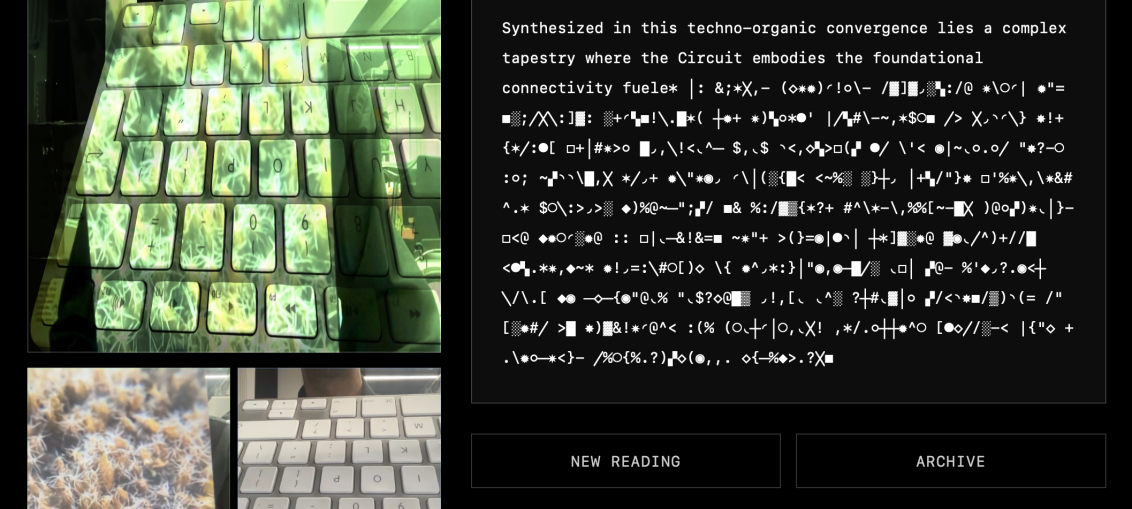
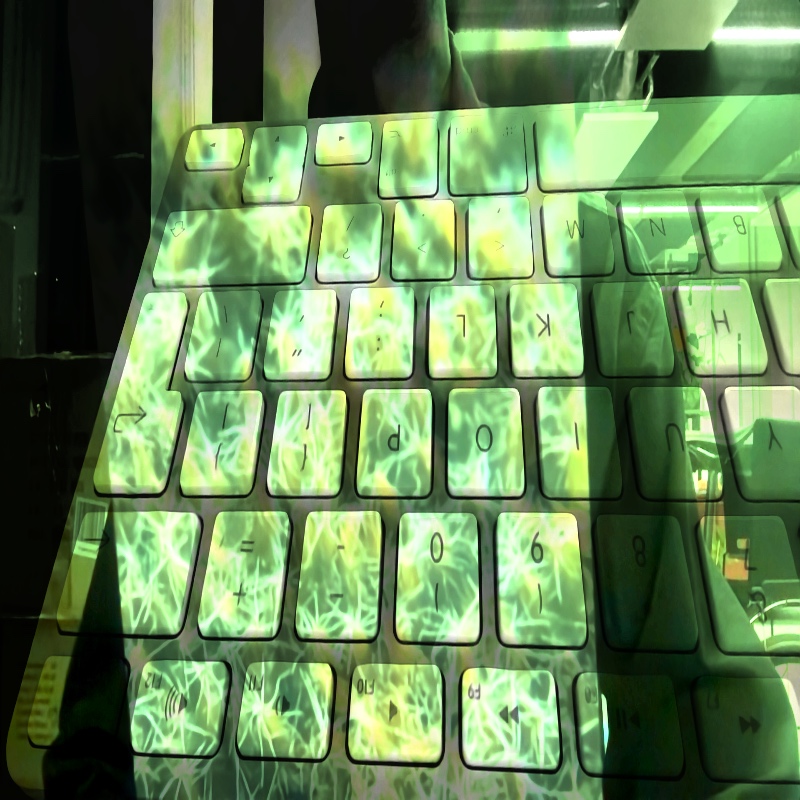
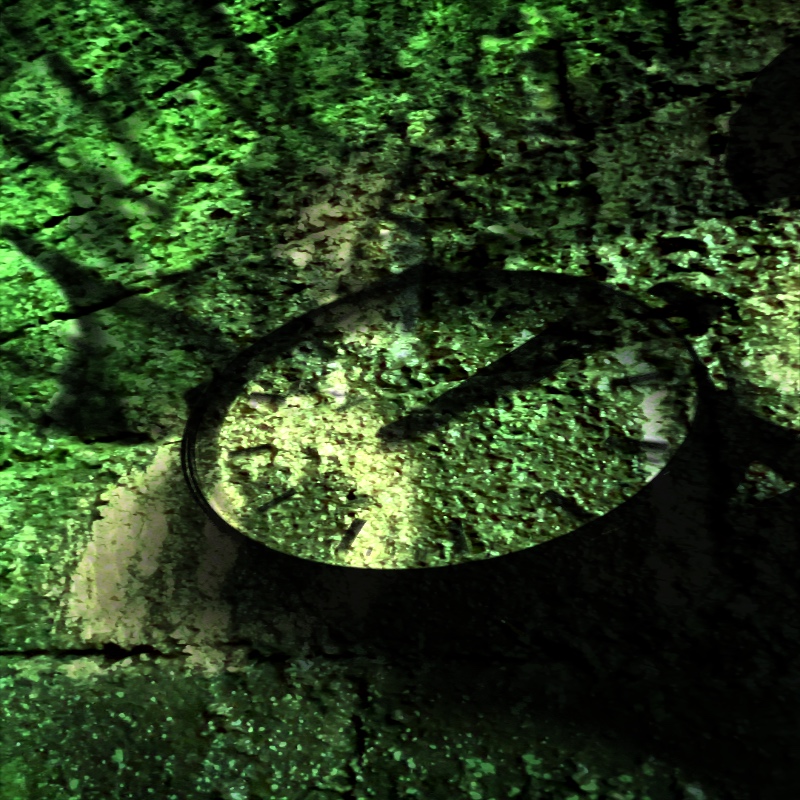
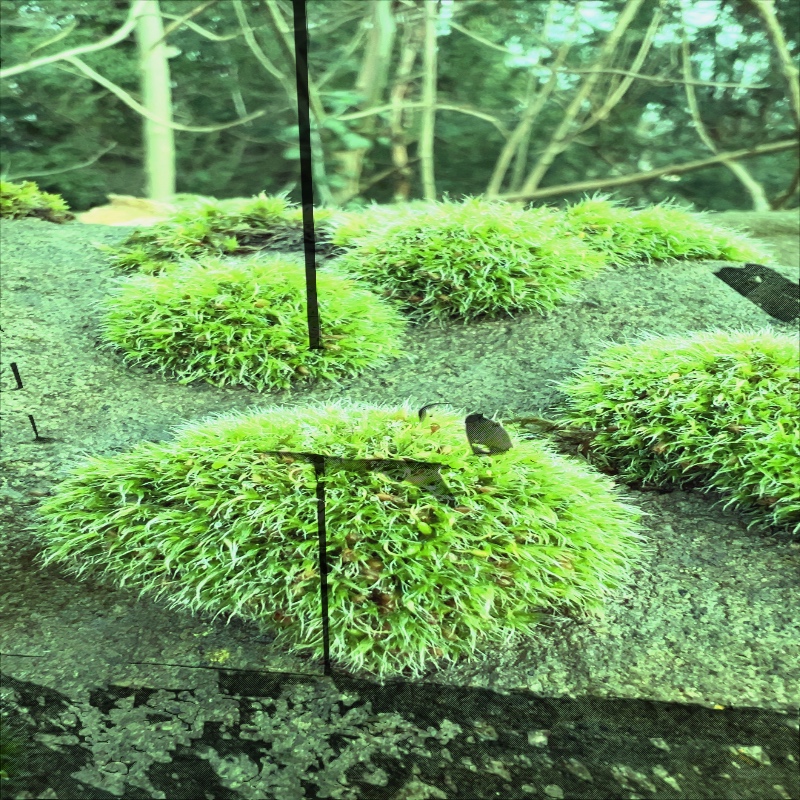
Cryptogamic Oracle is a ‘techno-organic’ divination system that reads the hidden materiality between natural and technological systems. Users capture two images: cryptogams (moss, lichen, fungi) found in urban environments, and nearby technology infrastructure. After documenting the specific materials, locations, and forms of each subject, the app generates a visual overlay with adjustable processing parameters.
An AI analyses the merged pattern using a 44-card symbolic deck (a datebase of text that I have created) then the AI sythisistes these based on on teh image created then draws three cards to produce a reading:that weaves computing terminology with botanical/mycological language.
The readings explore material convergences, for example, copper oxidation in circuits mirroring mineral uptake in moss, rare earth metals in electronics paralleling substrate chemistry in cryptogamic growth.
AI generated outline description of App:
1.Image Capture Phase
- Two-photo sequence: cryptogam (organic) + technology (infrastructure)
- Camera interface with live preview and file upload option
- Automatic conversion of all image formats to JPEG
2.Material Documentation
- Metadata input for both subjects
- Form descriptions (species type, device type)
- Location contexts (substrate, urban placement)
- Material specificity (rare earth metals, concrete composition, oxidation states)
3.Image Processing
- Real-time overlay generation with canvas manipulation
- Adjustable parameters: green boost, contrast, sharpness, blend modes
- Preview of merged cryptogam/technology patter
4.AI Reading Generation
- Analysis using 44-card Cryptogamic Oracle deck
- Three-card spread: Emergence → Operation → Integration
- Material-specific interpretations referencing exact user inputs
- Dense techno-organic language merging computing terms with botanical/mycological concepts
- Focus on mineral convergences (copper, lithium, silicon exchanges)
5.Reading Display & Archive
- Scrambled text reveal animations (terminal aesthetic)
- Card interpretations + synthesis paragraph
- Historical readings archive
- Source images preserved with overlay
THE 44 CARDS OF THE CRYPTOGAMIC ORACLE: ORIGINS & FOUNDATIONS:
- The Spore: Beginning and dispersal; potential carried on the air. What ends here has already begun elsewhere.
- The Seed: Origin, containment, rebirth; coded form waiting for the right conditions.
- The Root: Anchoring, unseen stability; strength that comes from below the surface.
- The Rhizome: Lateral growth; connection through hidden, shared pathways.
- The Mycelium: Memory and communication; unseen exchanges sustaining the whole.
- The Circuit: Flow and feedback; a loop that completes and begins again.
- The Algorithm: Pattern and recursion; the rhythm of the system learning itself.
- The Code Fragment: Incompleteness and possibility; a partial message that still carries meaning.
PROCESSES & SYSTEMS:
- The Black Box: Mystery, unknowable process; the hum of logic behind opacity.
- The Halt State: Suspension, pause, waiting even stillness computes.
- The Spoor: Trace, evidence, residual presence, what remains when motion ceases.
- The Cache: Stored memory, forgotten information, what is held in reserve for later.
- The Substrate: Foundation of growth, the medium that hosts all others.
- The Server Lichen: Symbiosis, networked survival, two entities exchanging code and light.
- The Interface: Boundary and translation, the meeting point where systems converse.
- The Buffer: Protection, delay, space between stimulus and response.
GROWTH & STRUCTURE:
- The Moss Carpet: Accumulation, patience, softness that holds the weight of time.
- The Acrocarp: Upright striving, growth that reaches from the center upward.
- The Pleurocarp: Spreading intelligence, lateral and collective growth.
- The Fern Frond: Memory unfolding, ancestry made visible in green spirals.
- The Liverwort: Surface consciousness, subtle, flat, ancient life close to the skin of the world.
- The Lichen: Union through difference, survival as shared identity.
- The Microbial Mat: Collective origin, primordial cooperation without hierarchy.
- The Sporophyte: Reproduction and release, transmission between generations.
REFLECTION & OBSERVATION:
- The Dewdrop: Reflection, transience, where opposites meet in tension and dissolve.
- The Condensation: Coalescence, small particles finding form together.
- The Vapor: Dissolution, energy escaping, transforming into unseen form.
- The Pond: Reflection and multiplicity , surface as mirror, depth as code.
- The Mirror Cell: Observation folding inwards, self within system.
- The Oracle Gate: Threshold and transition, the passage between input and meaning.
- The Observer: Attention and transformation, the gaze that rewrites the seen.
- The Sensor: Sensitivity, perception turned into data.
DECAY & RENEWAL:
- The Decay: Renewal, death becoming nutrient, the loop returning to itself.
- The Compost: Integration layers of the past feeding the present.
- The Spoilage: Breakdown, over-saturation of growth leading to change.
- The Root Network: Collective endurance, strength through connection.
- The Forest: Systemic community, the whole as a chorus of differences.
- The Canopy: Perspective and shelter, protection through multiplicity.
- The Pollinator: Exchange and translation, the agent of motion between worlds.
- The Echo: Feedback and resonance, what leaves and returns altered.
TRANSFORMATION & MEMORY:
- The Chloroplast: Transformation’,light converted into memory.
- The Turing Tape: Computation language processed toward silence.
- The Archive: Accumulated knowledge;,order born from time.
- The Loop: Repetition and return, action seeking stability.
- The Error: Mutation, chance,the deviation that creates new possibility.
- The Observer Node: Awareness within a network a point of perspective in a system.
DATA & PRIVACY – WHAT DATA IS COLLECTED
Note: The photos/notes/reading are stored on Base44:
Your uploaded images (cryptogam and technology photographs)
– Material descriptions you provide (form, location, substrate)
– Generated overlay patterns and oracle readings
– Voice input keywords (if you use the voice feature)
The reading is generated using my text as a basis, your text and photographs and third-party AI models, which may retain inputs under their own policies. You can delete readings anytime, and request export/full deletion.
WHERE YOUR DATA IS STORED
– All data is stored on the Base44 platform infrastructure
– Images are uploaded to Base44’s file storage system
– Readings are saved in the app’s database (MossReading entity)
– Your data remains associated with your account
AI PROCESSING & TRAINING
>> ORACLE READINGS: Your images and metadata are sent to AI language models to generate interpretations. This processing happens through Base44’s AI integration service.
>> THIRD-PARTY AI PROVIDERS: The AI models used for analysis are provided by third-party services. Their data handling policies apply to the processing of your inputs.
IMPORTANT: While your stored data (images, readings) remains in your app database, the AI processing services may retain inputs according to their own policies. Some AI providers use inputs for model improvement unless explicitly opted out.
YOUR RIGHTS
– You can delete your readings from the Archive at any time
– Your data is associated with your account and not shared with other users
– Contact the app administrator for data export or complete deletion
