A reflection on AI and oracular practices in relation to the Cryptogamic Oaracle Project.
The Cryptogamic Oracle draws on recent work that frames AI and algorithmic systems as oracle-like interfaces: tools that produce signs, prompts and patterns, rather than fixed truths. St. Lawrence describes technomancy as a form of algorithmic divination, where platforms become part of how signs and meanings are produced (St. Lawrence, 2024). Prock et al. frame AI-assisted tarot as a practice of resonance, randomness and negotiated meaning (Prock et al., 2026), while Schroeder et al. describe AI as a hermeneutic technology, where meaning emerges through interpretation rather than machine authority (Schroeder et al., 2025). For me, this positions the oracle as a reflective form: not something that predicts, but something that gives structure to interpretation.
My pond computer project was a personal response to the accelerated spread of AI: a deliberately slow, biotechnological experiment in non-human intelligence, built around feedback, learning and response, and drawing on Stafford Beer’s pond computer experiments. It raised a simple question: what would a pond computer do? How would a pond speak back? Because ponds, pools and reflective surfaces have long been associated with contemplation, divination and looking beyond the visible, I began to think of the pond computer as a reflective interface rather than simply a computational experiment.
Although the pond computer is currently on hold, the reading database I developed for it began to evolve into a tarot-like structure. I started testing a reading generator and explored whether each reading could be paired with a graphic, glyph or generative symbol drawn from pond life. The Cryptogamic Oracle grew from this point. It borrows the form of the oracle to ask how technical systems might guide attention, while also responding to the way AI is increasingly used for everyday guidance: writing, searching, navigating, deciding and asking for direction.
The Cryptogamic Oracle does not reveal hidden truths or predict the future. It creates a pause, offers a prompt and invites interpretation. AI remains present in a practical sense: in the making of the app, in the code, and in the wider infrastructures that support it. The system is therefore “oracular” in a limited way: it is consulted, it responds, and its response must be interpreted. It is also cryptogamic, not because it is alive or mystical, but because it works beneath the visible surface through technical dependencies that are not fully available to the user.
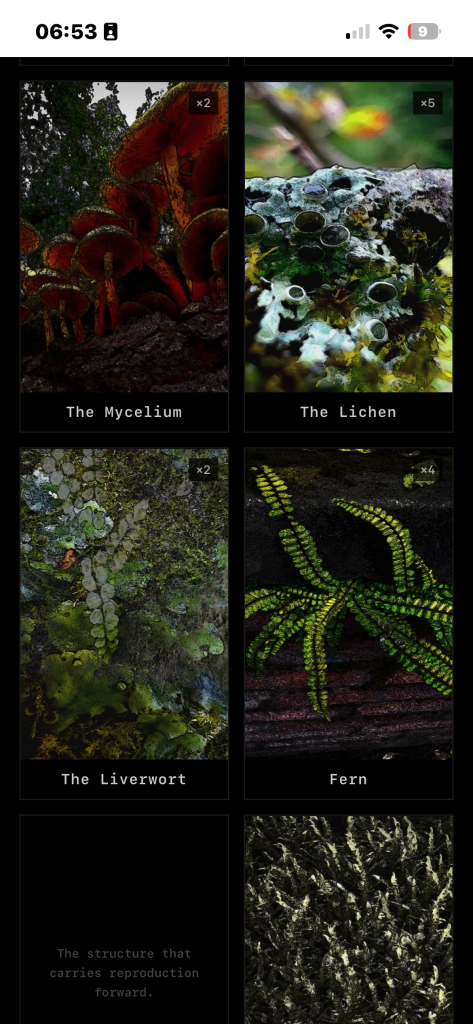
The card deck has gone through many iterations. It began as a non-human, ecologically focused deck that inverted the human-centred narratives often found in tarot. Later versions introduced eco-technological themes, before narrowing towards cryptogams and the wider idea of the cryptogamic: hidden growth, surface attention, technical opacity and forms of life that operate at the edge of visibility..
Back to main page…
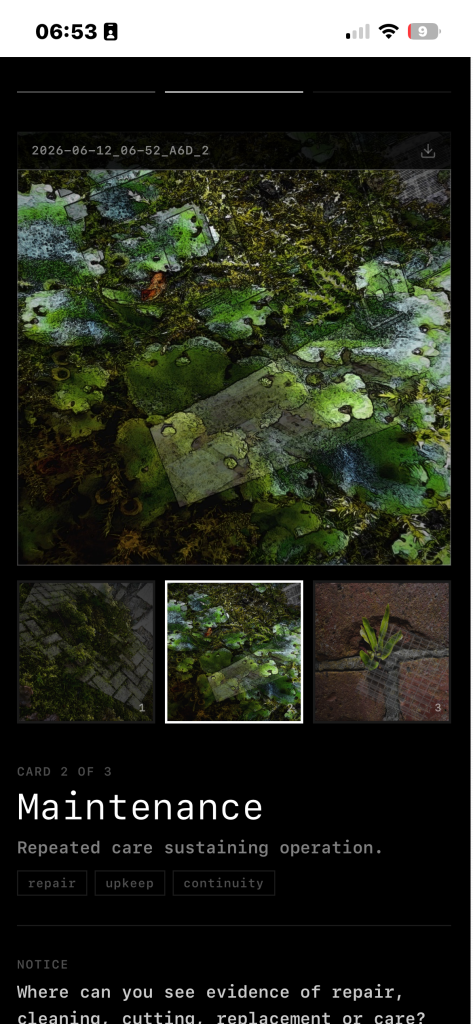
Here are the cards (version 7, updated 11 June 2026)
Prock, M.K., Epstein, Z., Schroeder, H., Smith, A., Lee, C., Goblot, V. and Jahanbakhsh, F. (2026) ‘Interpretive cultures: Resonance, randomness, and negotiated meaning for AI-assisted tarot divination’, Proceedings of the 2026 CHI Conference on Human Factors in Computing Systems. doi:10.1145/3772318.3791571.
Schroeder, H., Smith, A. and Epstein, Z. (2025) ‘AI Séance: Recounts from designing artificial intelligence for transcendence, interpretive lenses and chance’, European Journal of Cultural Studies, OnlineFirst. doi:10.1177/13675494251351223.
St. Lawrence, E. (2024) ‘The Algorithm Holy: TikTok, Technomancy, and the Rise of Algorithmic Divination’, Religions, 15(4), 435. doi:10.3390/rel15040435.
Welisch, G. and Basra, S. (2026) ‘AI & The Oracle: Future Interfacing Technical Objects and the Reflexive Practitioner in Futures Studies’, World Futures Review, OnlineFirst. doi:10.1177/19467567261428539.